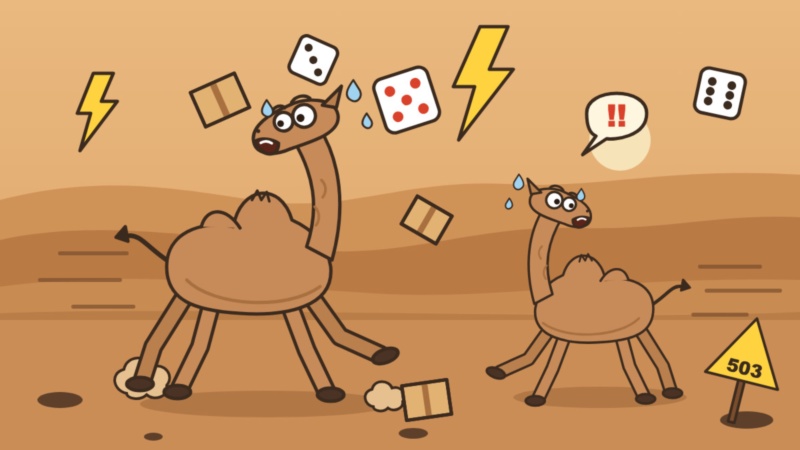
Camel has had error handling for as long as Camel has existed: redelivery, onException, the dead letter channel, and later the circuit breaker. You configure them, and then you hope. The day you find out whether they work is the day the payment service is down in production.
Camel 4.24 brings camel-chaos: turn on faults in a running integration while you develop it, and see how the routes cope. “Fail 25% of the calls to the payment service for 10 minutes.” “Stall route payment for 10 seconds.” “Fail the dead letter channel too.” Then a report says per route what completed, what was recovered by a retry, what the dead letter channel handled, and what was lost.
Chaos is for development only: it is on with profile dev, the default of camel run, and never with profile prod.
Try it with the example
The new chaos example is a small web shop. It takes an order every second, charges it at a payment service over HTTP, and hands it to shipping. A dead letter channel with two retries parks the orders it could not charge as files. Nothing in it fails on its own.
camel run * --chaosWhere do you start, with routes you did not write? Ask the integration. Chaos reads the routes and suggests what is worth trying first:
$ camel cmd chaos-suggest
Chaos rules to try, the most worth trying first:

1. route orders: Returns an error (HTTP status) (errors)
   an HTTP call to http://localhost:8080/payment without a circuit breaker: what does the route do when the service answers 503?
   camel cmd chaos-add --rule='endpoint=http://localhost:8080/payment error status=503 rate=0.25 until=10m'

2. route orders: The route after a hand-off fails (lost)
   route orders hands the message to route shipping over seda and does not wait: when shipping fails, is the message lost?
   camel cmd chaos-add --rule='route=shipping error rate=0.2 until=2m expect=orders->shipping:lost<=0 within=3m'
A rule is one line: what it targets, the fault, how often and for how long, and what must still hold. Add the first one, and the payment service answers 503 to one call in four:
$ camel cmd chaos-add --rule='endpoint=http://localhost:8080/payment error status=503 rate=0.25 until=10m'
Added chaos rule r1: fail 25% of the sends to http://localhost:8080/payment with HTTP status 503, for 10 minutes
The log fills with retries, and once in a while an order fails three times in a row and is parked. camel get chaos shows the effect of the rule as it runs: 60 recovered, 4 handled. Sixty orders were saved by a retry, four went to the dead letter channel. Nothing was lost.
Watch it happen
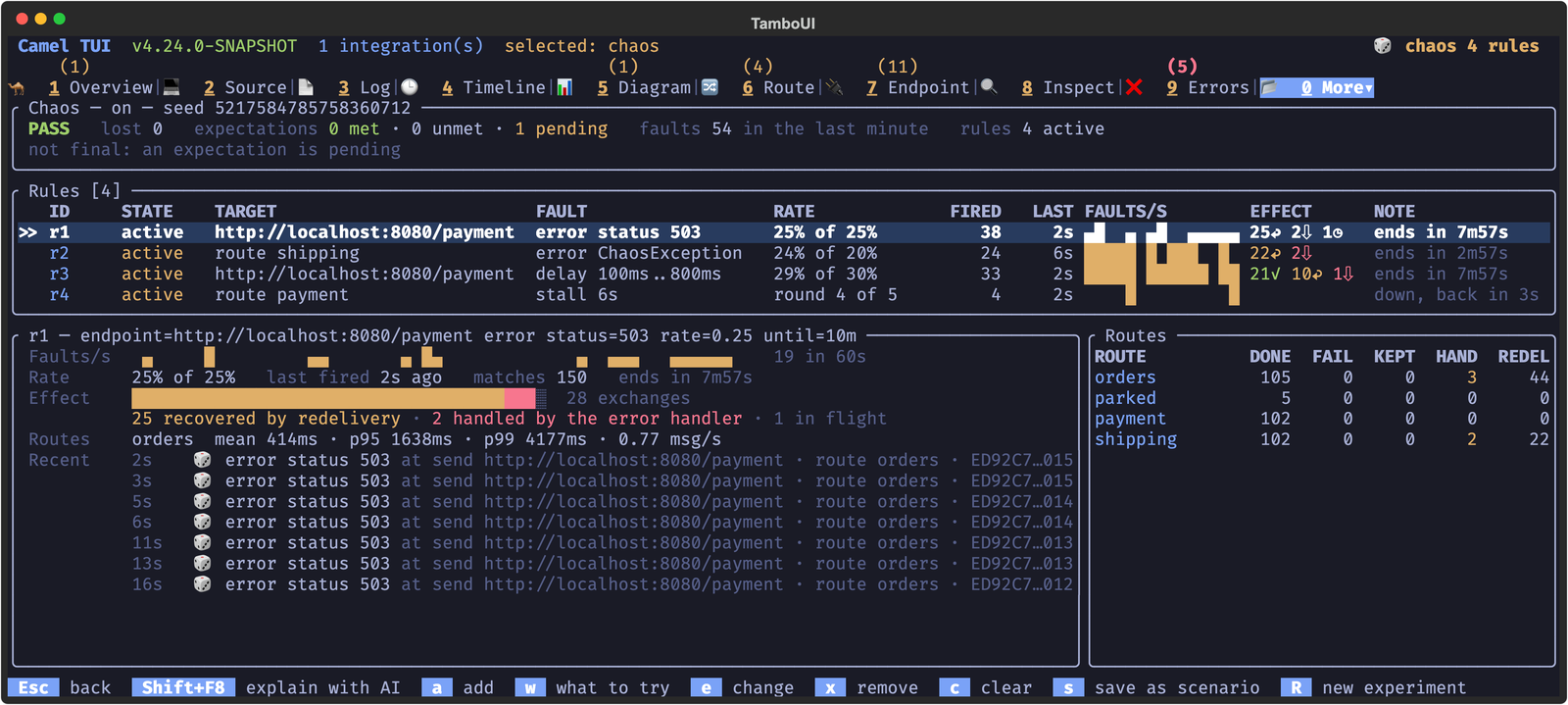
The Camel TUI has a chaos screen with the rules, their live rate, the faults per second, and what the faults did to the exchanges they hit. You can add, change and remove rules there too, and press w for what to try.
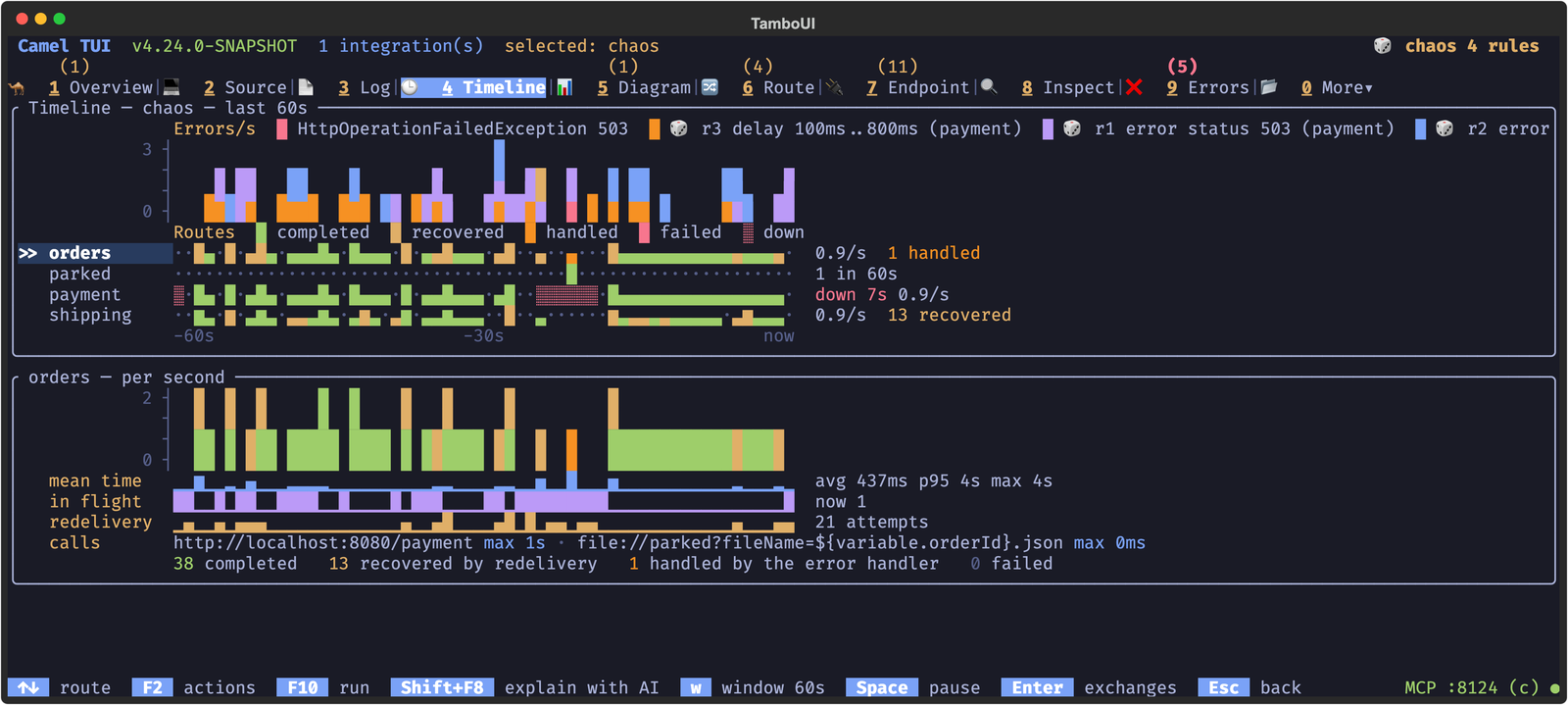
The timeline shows per second the faults of each rule and what each route did. Here route payment was taken down for six seconds, twice, and you can see the redeliveries in orders while it was gone:
When the last safety net fails
The dead letter channel is the last safety net. So what if it fails too? Take the payment service down for ten seconds, and fail the dead letter channel at the same time:
camel cmd chaos-add --rule='endpoint=http://localhost:8080/payment error status=503 until=10s' \
  --rule='endpoint=direct:parked error at=dlq until=10s'
The orders of those ten seconds are neither charged nor parked. They are gone, and all the log has for each of them is one more WARN among the retries. This is how messages get lost in production without anyone noticing. Chaos notices:
chaos (pid 58473): FAIL
  lost: 9
  FAIL: rule r5 failed or dropped 9 sends of the dead letter channel, which handled them without delivering them: 9 lost
A scenario as a gate in your build
Rules typed at the command line are an experiment. Rules in a file are a test. A scenario is a .chaos file in test/chaos, next to the other tests of the project, with one rule per line and a seed, so it fails the same messages every time it runs:
seed=42

# one call in four fails for 20 seconds: the redeliveries recover them, and the shop still takes 20 orders
endpoint=http://localhost:8080/payment error status=503 rate=0.25 until=20s expect=orders:20 within=25s
# shipping fails one message in five for 15 seconds: its redeliveries still ship every order charged
route=shipping error rate=0.2 until=15s expect=orders->shipping:lost<=0 within=20s
# then the payment service is down for 10 seconds: every order is charged or parked, none fails
route=payment stall duration=10s from=+20s expect=orders:failed<=0 within=15s
camel run * --chaos=test/chaos/payment-outage.chaos --max-seconds=45It ends with Chaos verdict: PASS (3 expectations met), and the verdict is the exit code: 0 for PASS, 1 for FAIL. So a CI pipeline can run it, and fail the build when a change to the error handling loses orders. In the TUI, s saves the rules you tried by hand as such a file.
Chaos found a bug on its first day
The example was written by an AI agent, which ran it with the Camel CLI, added chaos rules and read the log. It saw one order in shipping go to the dead letter channel after a single failure, without the two retries it should have had. It was an order whose payment had needed two retries earlier, in route orders. The redelivery counter of that first error handler stayed on the message, and the error handler in shipping started counting from it (CAMEL-26734). That is exactly the kind of thing chaos is for: a bug that hides until two failures meet.
Author’s note. Chaos in Camel has been a dream of mine for a long time. But it would have taken a lot of effort to build by hand, and the old world had settled the question anyway: testing is programming, and programming tests means JUnit. Today that is no longer the only pony in town.
The Camel CLI and TUI have in recent years been about trying things out quickly, and seeing with your own eyes what happens. And lately the AI can be your eyes, and act on your behalf with its thousand hands typing very fast on the keyboard. That makes you much quicker, and it opens another way to test: for real. Instead of hundreds of lines of Java, run the integration as it is, break it with chaos, and check it with a Citrus test, or with the deterministic simulation tests of
camel-test-dst.It is not all there yet, but this is part of the way.
There is more
The example shows a few of the faults. Some more of what chaos can do:
- More faults.
delaywith a range (duration=100ms..2s),dropa send or a poll,duplicatea send to test that the receiver is idempotent, andcorrupta message (random headers, a wrong charset, a truncated or empty body, a missing header). - Where it hits. At the send, at the reply of a call that succeeded (
at=reply), at the polls of a consumer (at=poll), at the entry of a route, at a single step, or at the dead letter channel (at=dlq). Narrow a rule to the calls of one route within=orders, or to some messages withwhen="${header.country} == 'ES'". - When it hits. A probability (
rate=0.3), every Nth message (rate=every:5), outage windows (rate=burst:5s/30s), after the warm-up (from=+30s), and always for a limited time: a forgotten rule cannot keep breaking your development instance. - Routes that flap.
stallsuspends a route,lifecyclestops it or removes it and adds it back, andrepeat=3 every=1mdoes it again and again. - Expectations. At least so many orders completed, nothing handled by the dead letter channel (
expect=orders:handled<=0), a limit on the redeliveries, the mean or max time of an exchange (expect=orders:meanTime<=2s), and no message lost between two routes. - From a real error to a regression test. On the Errors screen of the TUI,
!turns a real error into a rule that fails the same way again: fix the bug, then prove the fix against the same failure. Andton a rule asks the AI panel to make a test of it: a JUnit test withChaosAssertions, or a scenario. - For AI agents. The Camel MCP server has the chaos operations as tools, so an agent can ask what to try, check a rule before it adds it, and read the report.
- In tests. Chaos runs in a plain
Main, aCamelTestSupporttest, and in the deterministic simulation tests ofcamel-test-dst, where a ten minute stall takes milliseconds of virtual time. - Spring Boot.
camel run --chaosworks with--runtime=spring-boottoo, and for Quarkus a camel-quarkus-chaos extension is on its way.
The documentation has all of it.
Try it
Camel 4.24 is not released yet. If you want to try chaos now, the example runs with a 4.24 snapshot of the Camel CLI. We would love to hear what chaos finds in your routes, and what you miss: tell us on the mailing list or Zulip chat, or in Jira.
Happy breaking.